

Like the word leadership, the word alignment is hard to define. And I believe it leads to a lot of practical confusion in growing service firms where alignment with your clients and your team are critical. In this article, we’ll tackle alignment with your team, then we’ll follow up another article on aligning with your clients.
If you don’t have a precise definition of alignment, you can’t grow your role as a leader or your firm. And if you can’t define it, you can’t leverage it. And without leverage, your reach as a leader stays frustratingly small — no matter how hard you work.
What Alignment Is Not
Let’s start with what alignment is not, because the confusion here is where most leaders go wrong.
Alignment is not agreement.
This is the most important thing to understand. When leaders conflate alignment with agreement, they either demand false consensus — everyone nodding along in the meeting only to quietly resist afterward — or they tolerate real misalignment because the team seems to get along fine on the surface. Neither serves a growing firm.
Agreement means everyone gets their first choice. While alignment means something deeper and more durable: it means all parties can fully support the direction being taken, even when the practical outworking includes things they wouldn’t have chosen themselves. You can be aligned with someone you disagree with. In fact, that’s often where the most meaningful leadership happens.
So What Is Alignment?
Alignment is a foundational orientation between two parties — in this case, a leader and their team — built on three things: clear shared agreements, mutual trust, and a matching of how you lead with how your team wants to receive that leadership.
Think of it as being on the same page. Not the same sentence, not the same word — the same page. The team knows what they’ve committed to. The leader knows what they’ve committed to. And when things get unclear or hard — and they will — both parties know where to return. That shared page is the anchor.
These shared agreements can get foggy over time. They can be forgotten, misunderstood, or misapplied in the daily grind of running a firm. That’s normal. What matters is that they exist, and that both parties know how to find their way back to them. Alignment isn’t a one-time event. It’s an ongoing orientation that requires tending.
The “how” of alignment matters more than any specific outcome. Two team members can disagree on the best approach to a client project and still be deeply aligned. What keeps them aligned isn’t agreement on tactics — it’s trust. Trust is the ingredient that allows alignment to survive disagreement, absorb friction, and keep moving forward.
This is also why alignment is fundamentally a leadership move. It doesn’t emerge on its own. It doesn’t happen because your team is talented or because everyone gets along. A leader has to build it, tend it, and — when necessary — make hard decisions about it. That last part is what separates leaders who grow firms from those who merely manage them.
Why Alignment Gives You Leverage
Here’s where alignment becomes more than just a healthy team dynamic — it becomes a strategic resource for leadership.
Leverage, in this context, doesn’t mean using people. It means the methodology leaders use to expand their reach into the places they are meant to have influence. A growing firm requires a leader who can extend their influence beyond what they can personally touch, manage, or execute. That extension — that reach — is only possible when the team is aligned.
Think of it this way: if your team isn’t aligned with you, every initiative you launch requires more energy, more supervision, more convincing. You spend your leadership capital explaining initiatives, fighting the team’s own perspectives, and trying to ‘convince.’ Instead of building toward the future, you are just getting more exhausted. You can’t scale what you can’t trust. And you can’t trust what isn’t aligned.
But when alignment is present? Your influence multiplies. Your team carries the mission into corners of the firm you can’t personally occupy. They make decisions you would have made. They represent the culture you’ve built. That’s leverage. And leverage is what turns a solo practitioner into a firm leader, and a firm leader into someone who can actually grow the firm larger beyond themselves.
The chain looks like this:
Trust is the root. Alignment is the trunk. Leverage is the branch. Reach is the fruit.
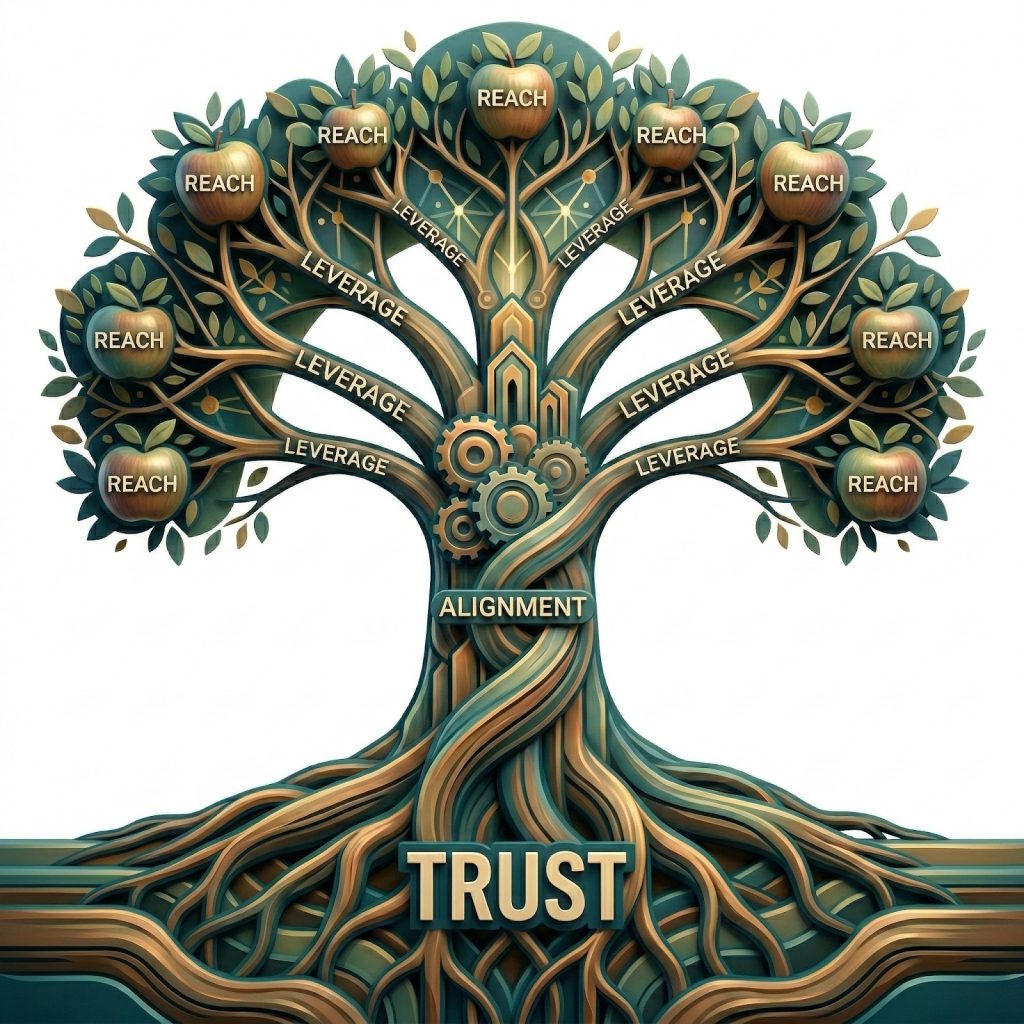
Break any link in that chain and growth stalls. A misaligned team doesn’t just create HR headaches — it caps what you as a leader can accomplish. Full stop.
Assessing Team Alignment
Because alignment isn’t intuitive, it requires assessment. You can’t manage what you don’t measure, and you can’t measure what you haven’t defined. That’s why we assess team alignment across four specific parameters, scoring each team member on a scale of 1 to 7 — where 1 means “not aligned at all” and 7 means “completely aligned.” The scoring is subjective and reflects the team member’s current state, not their potential or their tenure.
Here are the parameters we use to score our team’s alignment:
1. Core Values Alignment This is a culture parameter. It measures the degree to which a team member innately embodies and consistently displays the firm’s published core values. This isn’t about reciting the values from memory — it’s about living them without being reminded. A team member who scores low here displays a lack of care for the mission, skips cultural meetings or retreats, and generally treats the firm’s values as someone else’s concern. It’s very difficult to make someone care about the mission of an organization. Great team members come with that desire already built in.
2. Mind/Emotions Alignment This is a distractibility and awareness parameter. It measures whether a team member consistently manages their personal life in a way that enhances rather than disrupts their work. The opposite of this alignment looks like a team member who “disappears” — taking surprise trips, going dark without warning, or consistently letting personal chaos bleed into their professional reliability. Leaders have limited ability to influence team members in their personal lives, which is exactly why this parameter matters so much at the hiring stage.
3. Work Efficiency Alignment This is a work production parameter. It measures the amount of work a team member consistently outputs each week relative to the salary being paid for that output. The opposite here is the team member you have to micromanage — the one who always needs reminding to do their actual job. When a leader is constantly chasing output, they are spending leverage they don’t have on problems alignment should have prevented.
4. Future Commitment Alignment This is a commitment-to-leadership parameter. It measures a team member’s innate belief in the future value of the firm, their belief in their leader’s future stated direction, and expressed through their consistent dedication to their work and the company’s direction. The clearest sign of misalignment here is what leaders often call a “flight risk” — someone you fear is quietly getting ready to leave. A flight risk isn’t just a retention problem. They’re an alignment problem, and they actively drain the leverage a leader needs to move forward.
What to Do with Your Assessment
Once you’ve scored your team across these four parameters, patterns will emerge. Some team members will score consistently high — these are your aligned core, the people through whom your leverage flows most freely. Others will show gaps in one or two areas, which opens a coaching conversation. Still others may score consistently low across multiple parameters, and that requires a harder conversation — one that only a leader who understands alignment as a leadership move will be willing to have.
The goal is not to build a perfect team. The goal is to build an aligned one. And alignment, once built, becomes the foundation for everything else a growing firm needs: leverage, reach, and ultimately, growth.
In Part 2, we’ll take this same framework and apply it to your clients — because alignment doesn’t stop at the edge of your org chart. It extends all the way into your client relationships, and what you find there may surprise you just as much.
Jason Blumer, CPA is the founder and CEO of Thriveal, a coaching, training, and educational company serving entrepreneurial CPA firm owners. He also serves as CEO of Blumer & Associates CPAs. Through Thriveal’s coaching, consulting, and live events, Jason has guided hundreds of firms through strategic transformation.
What’s next for you? Join one of our programs and share your inspiration with other like-minded firm entrepreneurs.